On 5 October 2026, the SHAIPED Stakeholder Forum brought together notified bodies, HTA organisations, Health Data Access Bodies (HDABs), hospitals, industry and European projects at ParisSanté Campus in Paris, with participants also joining online. In the following days, the consortium stayed on at the same venue for the SHAIPED General Assembly to turn what was heard into the next steps of the project.
The Forum was built as a conversation rather than a series of presentations. As session moderator Persephone Doupi (THL) put it when opening the first panel: “There seems to be intention towards a common goal, but we don’t have the same views as to how to get there.” The afternoon set out to close some of that gap.
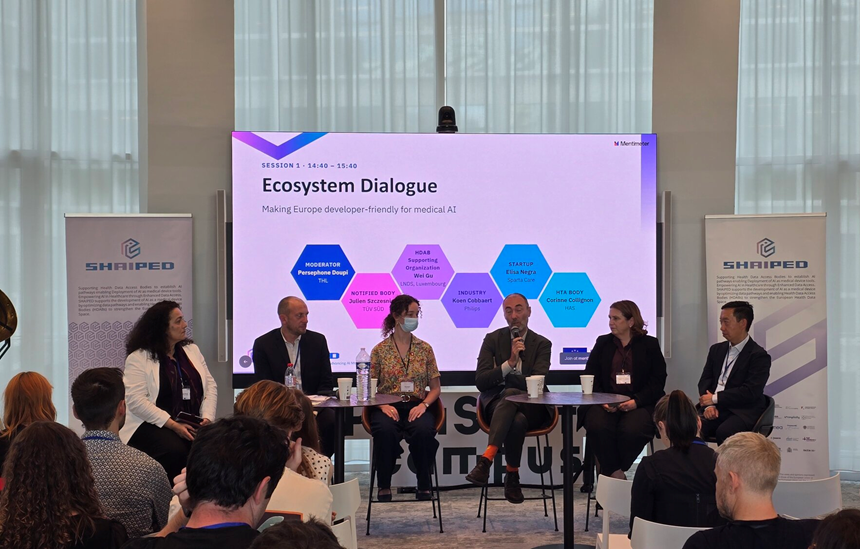
Session 1, “Ecosystem Dialogue”, at ParisSanté Campus.
Session 1 – Ecosystem Dialogue: Making Europe Developer-Friendly for Medical AI
Moderated by Persephone Doupi (THL), the first panel put the actors of the AI medical device pathway side by side: Ellisa Negra (Sparta Care), Julien Chesniak (Intuit Notified Body), Koen Cobbaert (Philips), Corinne Collignon (HAS, the French HTA body) and Wei Gu (Luxembourg National Data Service).
SMEs need a clearer map, not lower standards. Ellisa Negra stressed that MDR and AI Act requirements exist to keep AI clinically safe and free of drift. The hard part for startups is the ecosystem itself: unclear CE marking timelines and costs, scarce regulatory expertise, and the jump from public training datasets to well-labelled hospital data. Julien Szczesniak added that the lack of formal harmonisation remains a daily difficulty, and that developers need two distinct kinds of data: one to build the algorithm, another to prove its clinical safety and performance.
CE marking is only the first hurdle. Koen Cobbaert reminded the room that a notified body certificate proves theoretical performance. “That’s the first hurdle you’ve taken. It’s a difficult one, but it’s not the most difficult one.” Reimbursement and hospital integration come next. He pointed to real-world testing under the AI Act as a way to collect evidence for all three steps at once, provided the EHDS can deliver near-real-time data linked to the device used.
Performance is not the same as value. From the HTA side, Corinne Collignon explained that reimbursement depends on clinical or organisational impact in the care pathway: “a reliable algorithm is not automatically a valuable healthcare improvement.” Her advice to developers: plan CE marking and HTA evidence together.
HDABs can move faster by design. Wei Gu proposed three accelerators for data access: tiered datasets (synthetic or lower-resolution data for early exploration), structured, machine-readable application forms, and formal amendment pathways for approved projects. He also warned about the next bottleneck, reviewing exported models that can be “maybe hundreds of gigabytes” for data leakage.
The panel also covered regulatory sandboxes (with the UK Commission on the Future Regulation of AI in Health as an example of all stakeholders at one table), French early reimbursement pathways such as PECAN, and Predetermined Change Control Plans (PCCPs) for adaptive AI, where Ellisa Negra suggested startups start with a one-year change forecast to build trust with their notified body.
Session 2 – Data Readiness Reality Check: Is the Data Actually AI-Ready?
After the coffee break, Nienke Schutte (Sciensano) moderated a more hands-on session. Six lightning pitches set the scene before the roundtable, from Paul-Antoine Baudoin (CHU Grenoble Alpes), Jacob Berthelsen (Enversion), Enrique Bernard Delgado (IACS Aragon / QUANTUM), joining online, Pero Ivanko (CIPH), Ahmed Yusuf Ali (Johnson & Johnson / SYNTHIA) and Cristiana Costa (Instituto Pedro Nunes / TEF Health).
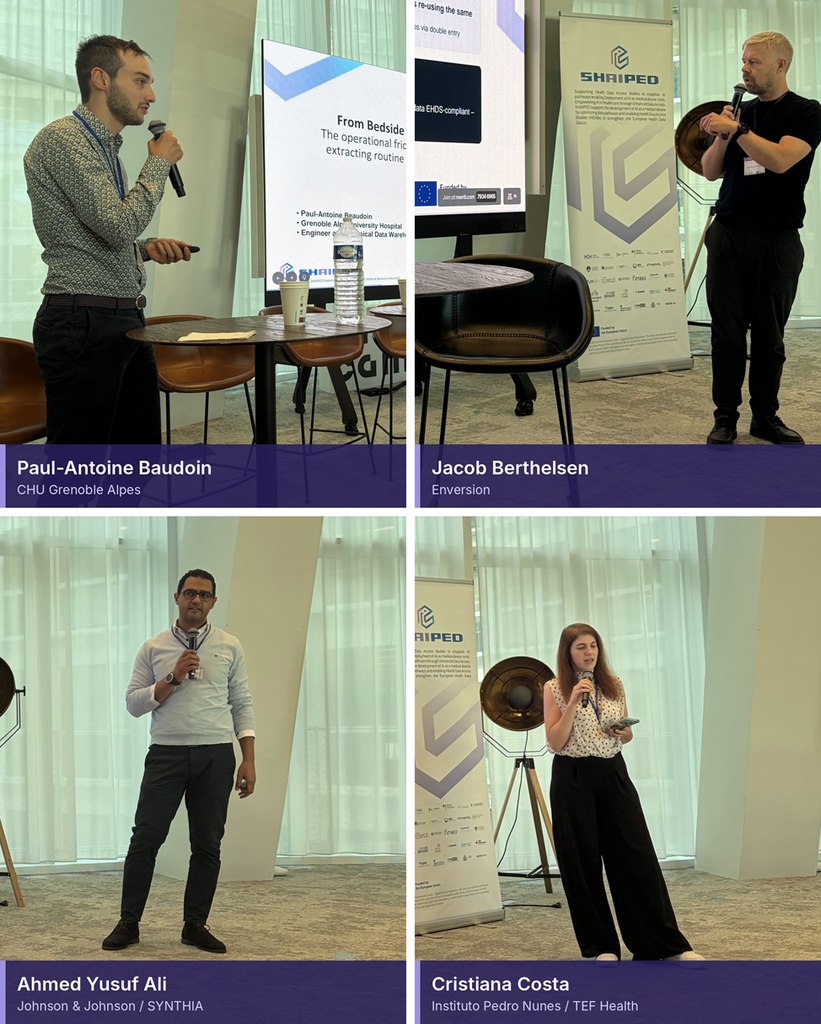
Lightning pitches opened Session 2.
Hospital data is made for care, not for reuse. Paul-Antoine Baudoin described records written at the bedside for speed, full of jargon, with most clinical information locked in free text. Pero Ivanko shared that in Croatian EHDS pilot challenges, 60% of preparation time went into extracting and preparing data, much of it from PDFs, or “electronic paper”. He pointed to OMOP and federated analytics, as proven in EMA’s DARWIN EU network, as a working route to standardisation.
Infrastructure is the real gap. Jacob Berthelsen estimated that making Danish legacy systems EHDS-ready could cost €50–100 million for a small country. Recalling six years spent getting a validated algorithm close to real-time data, he said of European AI companies: “They’ve gone from AI startups to infrastructure builders.” Enrique Bernard Delgado presented the QUANTUM data quality and utility label as a first screening tool, while true AI readiness can only be judged through a fitness-for-purpose assessment inside the Secure Processing Environment (SPE).
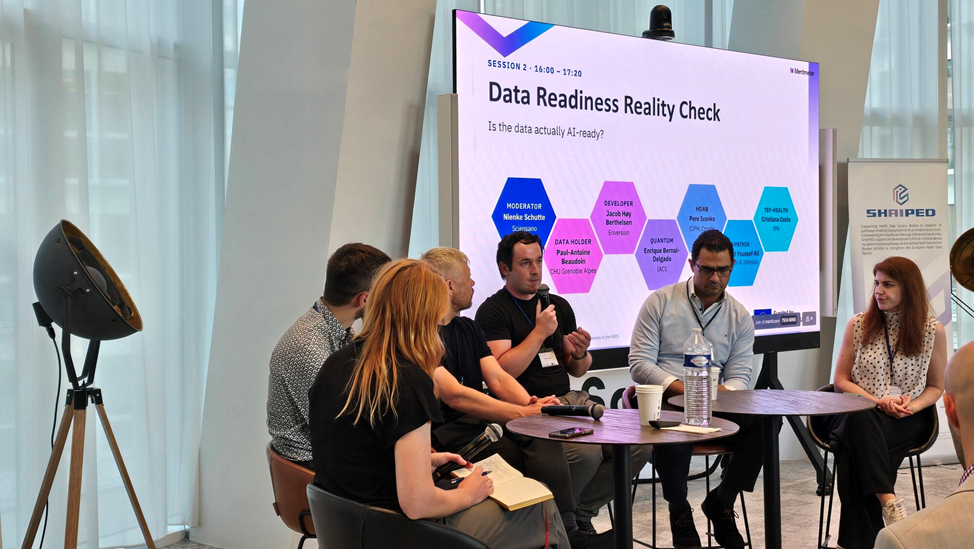
The Session 2 roundtable on data readiness.
Synthetic data: useful, but not the whole answer. Ahmed Yusuf Ali argued that validation of privacy, utility, fidelity and bias matters more than generation itself. Cristiana Costa saw synthetic data as helpful early on but risky if it hides the messiness of real hospital workflows, and Jacob Berthelsen said he would not base a regulatory submission on it.
Compute must reach the data. Panellists flagged a shortage of GPU resources in SPEs. Enrique Bernard Delgado asked why the EHDS does not connect by design to Europe’s existing supercomputing networks: “we are not connecting the dots?” Wei Gu noted that the SCAILED project is already working to link AI factory compute to HDABs.
The General Assembly: From Discussion to Next Steps
Following the Forum, the SHAIPED consortium gathered in the same venue at ParisSanté Campus for its General Assembly. With the project at its midpoint, partners reviewed progress across the work packages and use cases and agreed on priorities for the next reporting period.
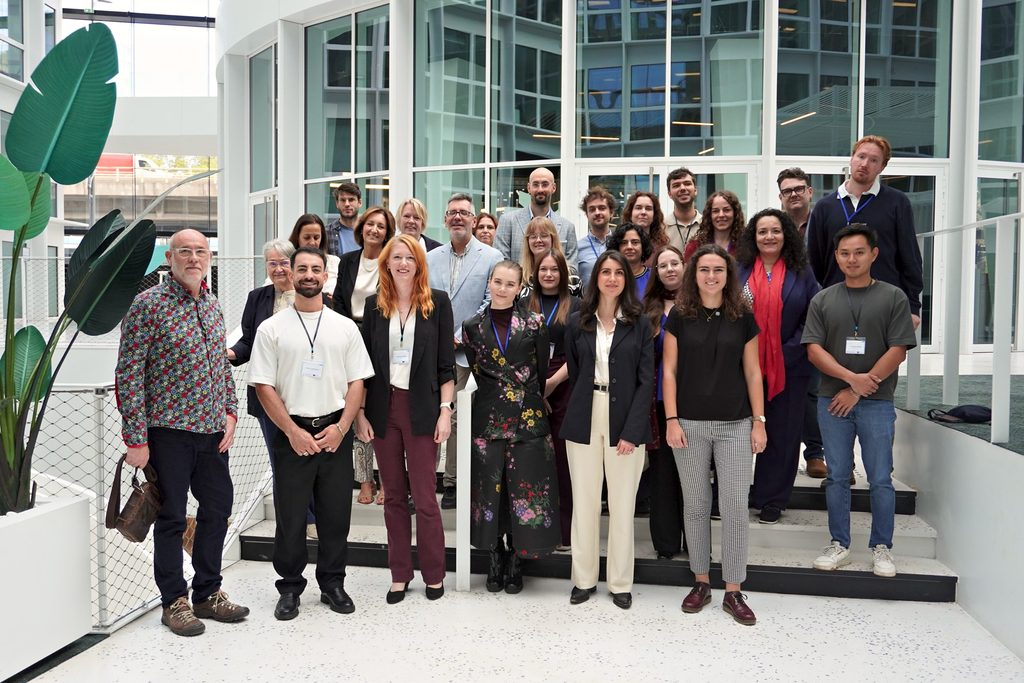
The General Assembly group photo.
The Forum’s discussions fed directly into this work, from real-world testing and HDAB service design to data readiness and SPE compute. The Paris week concluded with meetings and a presentation of SHAIPED’s work to the European Commission.
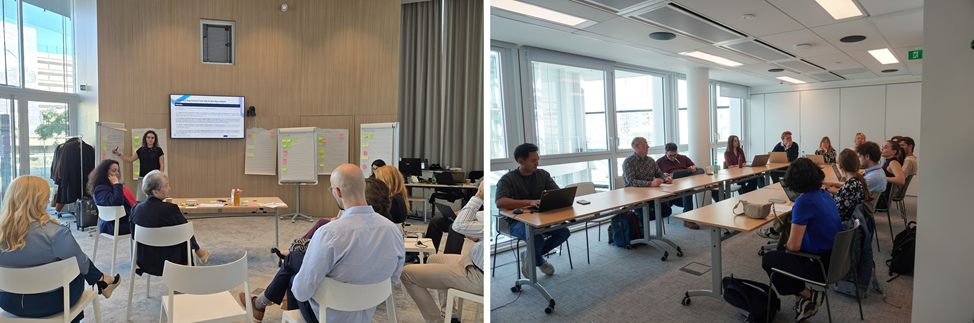
Parallel working sessions during the General Assembly.
Looking Ahead
The Forum confirmed what SHAIPED set out to address: Europe has the regulations, the expertise and much of the data, but the pieces are not yet connected. Closing the first panel, Persephone Doupi noted that a project cannot solve every problem, but it can offer the space for these conversations, because “when you put clever people together, you may come up with some clever answers as well.”
The insights gathered in Paris will feed into SHAIPED’s work on pathways for developing, testing and deploying AI medical devices through HDABs.
A huge thank you to our moderators, panellists, pitch speakers and everyone who joined us in Paris and online.
Stay tuned for more updates and follow SHAIPED on LinkedIn and X.