SHAIPED consortium comprising research institutions, regulators, data access bodies and innovators from across Europe is committed to advancing artificial intelligence in medical devices by enabling secure and efficient access to health data within a legally robust and ethically sound framework. SHAIPED’s mission aligns with the European Health Data Space regulation, effective from 26 March 2025, which establishes a legal framework for cross-border use and reuse of electronic health data, empowering individuals while enabling secure secondary use for research, innovation, policy and regulation
With the EHDS phased implementation requiring key acts by 2027 and full application by 2029, embedding ethical oversight from the start is essential. This ensures privacy, transparency, fairness and accountability supporting compliance with GDPR, EHDS and upcoming AI legislation while fostering public trust. Dr. Ségolène Aymé will advise the consortium to align its work with evolving ethical and regulatory standards, keeping SHAIPED innovative and responsible.
Why an Ethics Advisor is Crucial for SHAIPED
Integrating AI into healthcare offers transformative opportunities but also presents complex ethical challenges. AI systems can enhance diagnostics, optimise workflows and provide scalable access to high-quality care, yet their deployment raises critical concerns around patient autonomy, algorithmic fairness, transparency, data privacy and accountability. SHAIPED project, which focuses on cross-border medical data sharing and AI-driven validation of medical devices, addresses these challenges by appointing an independent Ethics Advisor. This role, designed for projects facing substantial ethical considerations, ensures that SHAIPED adheres to ethical, legal, and regulatory requirements, including GDPR, the EU Medical Device Regulation, and the emerging EHDS.
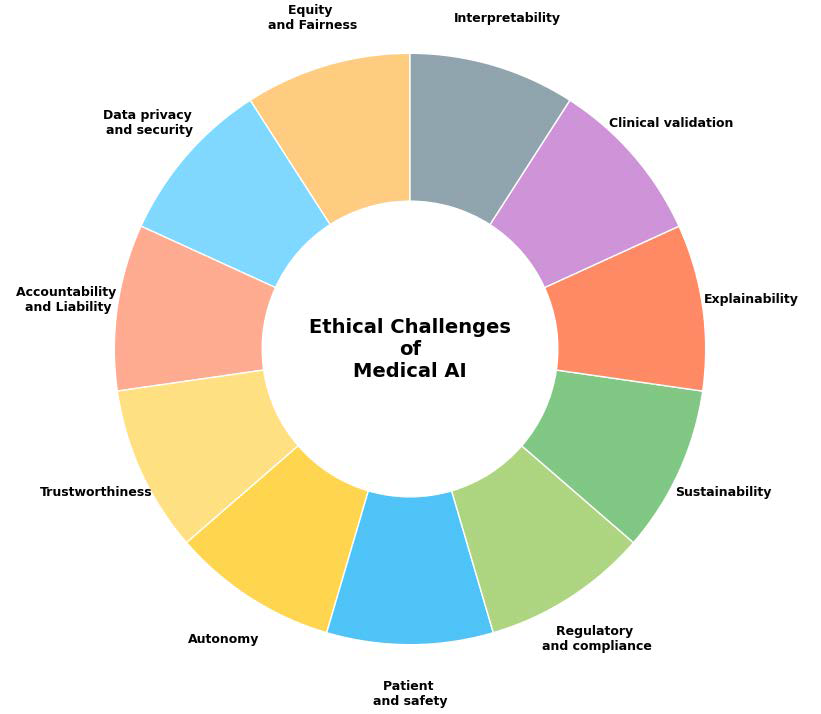
Figure 1, adapted from Jha et al., 2025, illustrates key ethical dimensions of medical AI including data governance, bias mitigation, explainability, clinical validation and accountability. Within this framework, SHAIPED’s Ethics Advisor provides continuous guidance throughout the project lifecycle, ensuring that AI models are trained on ethically sourced, representative datasets, that privacy and consent protocols are strictly adhered to, and that clinical validation incorporates human oversight. By operationalising high-level ethical principles such as autonomy, fairness, transparency, and sustainability across data collection, model development, and deployment, SHAIPED promotes trustworthy AI practices while safeguarding patient rights and fostering equitable healthcare access.
Ethical Oversight: Building Trust in Health AI
Independent ethical oversight is vital for maintaining public trust as healthcare AI advances. Experts consistently emphasise that transparent and robust ethical governance is essential to ensure AI tools are safe, fair, and reliable for both patients and clinicians. For example, under the EU Artificial Intelligence Act, high-risk AI systems in healthcare must be designed, developed, and deployed to ensure safety, transparency, human oversight, and respect for fundamental rights, thereby promoting ethical, equitable and responsible use..
In SHAIPED, Dr. Aymé serves as the Ethics Advisor, guiding the project on ethical issues and ensuring compliance with all relevant ethical requirements. Her responsibilities include producing reports reviewing the project’s policies and deliverables, including general ethics briefs and data use frameworks. She advises on potential ethical risks, assesses alignment with EU values and human rights, and recommends measures to uphold fairness, transparency, and accountability. These activities directly support the objectives of the EU AI Act, helping SHAIPED promote trustworthy and responsible AI in healthcare.
About Dr. Ségolène Aymé
Dr. Ségolène Aymé is a distinguished medical geneticist and expert in rare diseases and health data ethics. She is Emeritus Director of Research at INSERM, the French Institute of Health and Medical Research and in December 2022 was appointed President of the Scientific Advisory Board of France’s Health Data Hub.

Dr. Aymé founded Orphanet in 1997, the leading information portal for rare diseases and orphan drugs, and led it as Executive Manager until 2011. She has also held prominent leadership positions in European and global rare disease policy bodies, including Chair of the European Committee of Experts on Rare Diseases and membership in the WHO Topic Advisory Group on Rare Diseases.
Her ethical leadership is extensive. She is President of the Comité d’éthique et de déontologie, the Ethics and Professional Conduct Committee, at the Paris Brain Institute, and has participated in ethics oversight in genetics policy and research through various EU and WHO expert committees. This combination of deep expertise in genetics and rare diseases, alongside leadership in ethics and data policy, uniquely equips her for the SHAIPED role, particularly in complex areas such as data governance, safeguarding vulnerable patient groups and ensuring ethical compliance in cross-border health AI.
SHAIPED’s Commitment to Responsible Innovation
Dr. Aymé’s appointment underscores SHAIPED’s commitment to ethical, regulation-aligned innovation alongside technical achievement. Her advisory role spans the entire project, informing all work packages, from drafting guidelines for secure data access to interpreting AI Act requirements for clinical tools. This ensures that SHAIPED’s deliverables consistently reflect ethical best practices. By integrating an Ethics Advisor from the outset, SHAIPED demonstrates a proactive approach, developing AI medical devices not only to meet market needs but also to satisfy societal expectations for transparency, fairness, and patient-centric care.
Through this approach, SHAIPED reinforces the EU’s vision of a secure, citizen-empowered health data space. As part of Europe’s digital health strategy, the project contributes to the practical implementation of the new EHDS rules and forthcoming AI legislation. In short, the consortium aims to serve as a model for responsible development of AI medical devices, protecting individuals while fostering innovation.